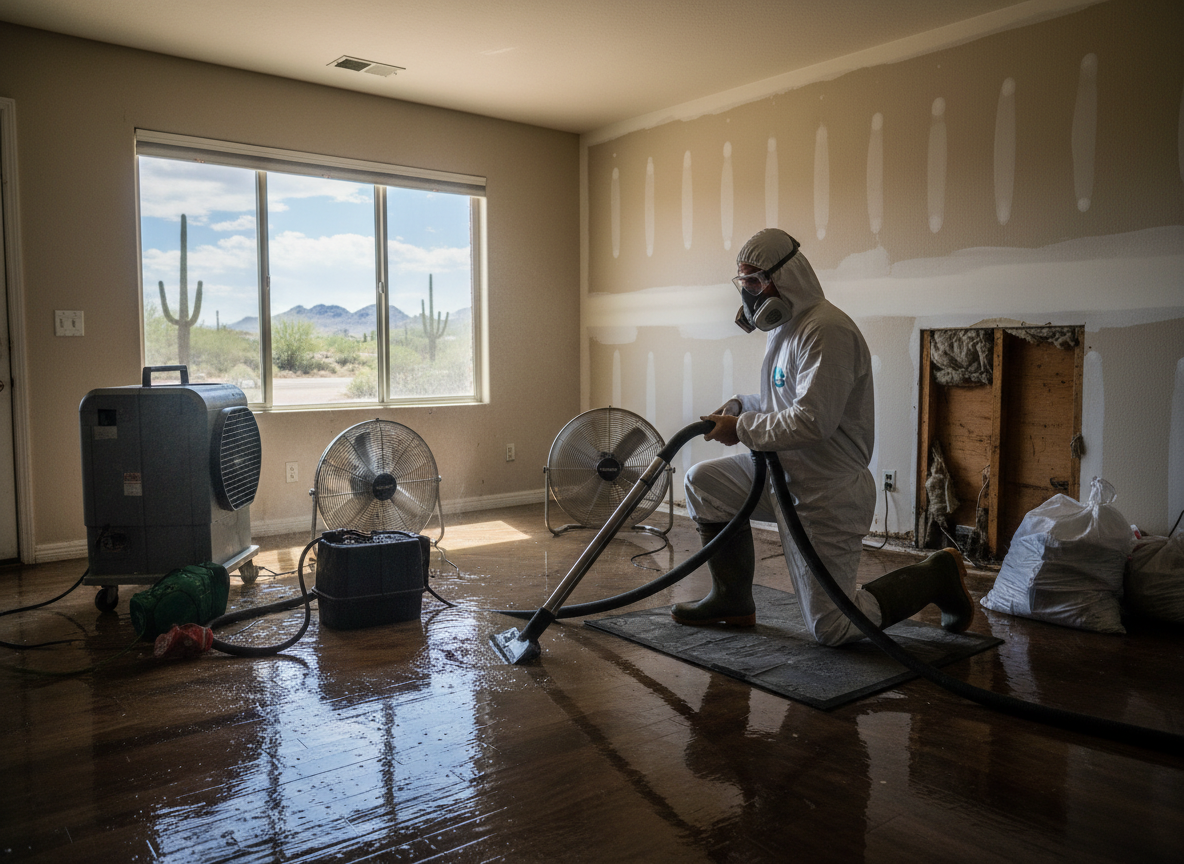
Phoenix homes built before 1980 in Maryvale and Camelback East often feature slab-on-grade construction with limited crawl space access, so flood water from monsoon runoff or broken irrigation lines can migrate under tile and into wall cavities without obvious surface signs. Technicians must pull baseboards and use moisture meters along the entire perimeter because the extreme summer heat drives evaporation upward, pushing hidden moisture into drywall and creating conditions for rapid mold growth within 48 hours.
In neighborhoods like Ahwatukee and South Mountain, stucco exteriors and flat roofs channel water toward window wells and patio doors during heavy rain events. Restoration crews frequently encounter saturated insulation behind exterior walls that must be removed in sections rather than full gutting when the damage stays below the two-foot mark. Local building practices from the 1990s also left many garages with unsealed expansion joints that allow water to reach HVAC platforms, requiring targeted drying under equipment to avoid future corrosion.
Flash flooding along washes near Papago Park and the Phoenix Zoo can deposit sediment inside finished basements in Arcadia properties. Crews use negative air machines during extraction to keep dust and bacteria from spreading into living spaces, then apply antimicrobial rinses rated for porous materials because the desert soil here contains high alkaline content that can leave residue affecting new finishes if not neutralized.
Technician insight
In Phoenix the thing that catches most people out with flood damage is how fast monsoon water travels under 1970s slab homes in Camelback East and Arcadia; the extreme heat pulls moisture into drywall cavities within two days, so skipping perimeter baseboard removal almost always leads to hidden mold later.
Monsoon Runoff into Arcadia Garage
Heavy rain sent water under the garage slab of a 1978 home near Camelback Mountain. Moisture had wicked into the adjacent laundry room drywall and underlayment. Crews extracted sediment, removed two feet of drywall, and ran drying equipment for five days until readings dropped below 12 percent. The homeowner avoided a full room rebuild and returned to normal use within a week.
Flood Damage Restoration Services We Offer
✓Monsoon Flood Extraction
Rapid removal of standing water from living spaces and garages after summer storms, using truck-mounted pumps suited for Phoenix sediment loads.
✓Sewage Backup Restoration
Contaminated water cleanup from municipal line failures common in older Maricopa County neighborhoods, including full disinfection and porous material removal.
✓Structural Drying After Flooding
Industrial dehumidification and air movement tailored to Phoenix heat, preventing secondary damage in stucco and slab homes across Biltmore and Arcadia.
✓Flood-Damaged Drywall Replacement
Targeted removal and reinstallation of saturated drywall up to code height, accounting for older plaster-and-lath construction found in Maryvale.
✓Carpet and Flooring Restoration Post-Flood
Salvage or replacement of waterlogged carpet, tile, and hardwood in homes near Tempe and Scottsdale where irrigation overflows frequently occur.
Flood Damage Restoration Cost in Phoenix, AZ
| Service | Typical Range | What Affects It |
|---|---|---|
| Initial Assessment and Moisture Mapping | Free | For all Phoenix and nearby Scottsdale, Tempe, Mesa properties |
| Water Extraction | $600–$1,800 | Varies with depth, sediment load, and access in older Maryvale or Ahwatukee homes |
| Structural Drying Package | $800–$2,400 | Includes equipment and daily monitoring through Phoenix summer conditions |
| Drywall Removal and Replacement | $1.50–$3.50 per sq ft | Depends on wall height and whether plaster-and-lath is present |
Ranges are typical for Phoenix, AZ and confirmed with an exact written quote before any work starts.
How it works
- 1
On-Site Assessment
Technicians inspect affected rooms in Phoenix homes, map moisture migration through slabs and walls, and document conditions before any work begins.
- 2
Water Extraction
Standing water and sediment are removed using equipment sized for desert soil loads, protecting nearby structures in dense neighborhoods like South Mountain.
- 3
Drying and Monitoring
High-velocity air and dehumidifiers run until moisture readings stabilize, with daily checks to counter Phoenix's rapid evaporation rates.
- 4
Sanitizing and Repairs
Affected materials receive antimicrobial treatment followed by replacement of drywall, insulation, and flooring as needed.
Pricing
Upfront written estimates provided after on-site inspection; final cost depends on water volume, access, and material replacement needs.